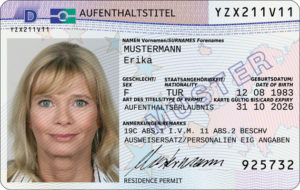
Family Reunification Visa Family reunification in Germany allows close family members to join their relatives living in Germany—whether those relatives are German citizens or third-country nationals with valid residence (Aufenthaltserlaubnis) or settlement permits (Niederlassungserlaubnis). Eligible family members include: Spouses or registered partners Minor children to foreign parent (unmarried) Parents of a minor German Child These rules focus on preserving the nuclear family. Other relatives, such as adult children, siblings, grandparents, or extended family, are not normally eligible, unless there are exceptional humanitarian or personal hardship circumstances that justify reunification. Immigration authorities evaluate such cases very strictly, and approvals are rare. Visa and Residence Permit: What You Need to Know To join a family member in Germany, you’ll need to go through a two-step process: First, apply for a national visa while still in South Africa. This visa allows you to enter Germany for the purpose of family reunification. After arrival, you must apply for a residence permit from the local immigration office (Ausländerbehörde) in Germany to legally remain long-term. Please note that the rules and requirements differ based on both your citizenship and the citizenship of the family member you are joining. As a general rule, the conditions vary depending on whether you are joining: A German national An EU citizen A third-country national (non-EU) Each category has its own conditions, documentation requirements, and processing times, so it’s essential to check the correct guidelines for your situation before beginning your application. 👉 Important Note:If you’re planning a short-term stay, such as visiting a relative or friend in Germany for a few weeks or months, this is not the right visa for you. For temporary visits, such as attending family events, holidays, or simply spending time with loved ones, a different visa category applies. Info on the web As the rules and requirements change regularly, please refer to the official websites for information on a family reunification visa. Bamf – Information for 3rd Country Nationals Berlin Welcome Centre Federal office for migration and refugees. Family Reunificationof third-country nationals in Germany – See page 39 for employment restrictions The Federal Government – At a glance: Visa for the purpose of family reunification to foreigners Where to apply You need to submit your application at the German Embassy in South Africa, or at one of the German Consulates in South Africa. You cannot apply for a family reunification visa from inside Germany. The following types of Family reunification Visas are available Spouse Parent to a minor German child Child to a foreign parent Family members of non-German EU citizens Proof of knowledge of basic German To join your spouse in Germany, you must demonstrate at least basic proficiency in the German language (equivalent to Level A1 of the European Language Framework).For more information, you can find a flyer from BAMF (Bundesamt für Migration und Flüchtlinge) here We summarised the possible exceptions, but please always refer back to the official information from BAMF: You or your spouse are a citizen of a member state of the European Union or you have exercised your right of free movement as a German citizen. Your spouse is a citizen of Australia, Israel, Japan, Canada, the Republic of Korea, New Zealand, the United Kingdom, the United States of America, Andorra, Brazil, El Salvador, Honduras, Monaco, or San Marino. You have a university degree and can probably find work in Germany thanks to your language skills. Your spouse holds an EU Blue Card. Your spouse holds a residence permit as a skilled worker (§ 18c (3) German Residence Act (AufenthG)). a researcher 2 (§ 18f AufenthG). a selfemployed person 2 (§ 21 AufenthG). a person entitled to asylum (§ 25 (1) and § 26 (3) AufenthG) to whom you were already married in yourhome country before your partner moved to Germany. a person who has been granted refugee status or subsidiary protection (§ 25 (2) and § 26 (3) AufenthG) to whom you were already married in your home country before your partner moved to Germany. a longterm resident from another EU member state (§ 38a AufenthG). You do not wish to remain permanently in Germany. It is impossible or unreasonable to learn the language abroad, or this has proven unsuccessful despite your attempts. You are unable to prove basic knowledge of German on account of a physical, mental or psychological illness or disability. You are able to cite other circumstances that make it impossible for you to learn the language, circumstances that could constitute a case of hardship. Employment Joining a third-country national. According to BAMF documentation, If you are joining your spouse who is a third-country national you are also entitled to take up work if you come to Germany for the purposes of family reunification. Joining a German spouseAccording to BAMF documentation, family members coming to Germany to join their German spouses, for the purpose of family reunification are allowed to work in Germany. Medical For comprehensive guidance on your visa application, read our detailed tips regarding medical insurance coverage—an important requirement to ensure your application proceeds smoothly and meets all necessary criteria. Additional information and tips When a birth or marriage certificate is required, it must always be an unabridged copy The embassy only accepts Marriage certificates that were apostilled by DIRCO Unabridged birth certificates must also be apostilled by DIRCO We have companies listed that can assist in obtaining unabridged documentation, but remember they cannot speed up the process at DIRCO. You can find a list of these companies here When your spouse is already in Germany, it is sufficient to supply a copy of their “Anmeldung” you do not have to wait for a copy of their residence card to submit your application. As with all visa applications, make sure you supply all the documentation required on the Checklist Unless specifically asked for, documents that are in English does not need to be translated During your interview, ask if you can keep your passport with you, as the process can take a long time (months), and you will only get your passport back when the visa is issued. It is impossible to know how long
You must be logged in to post a comment.